
Medievalknight.ca

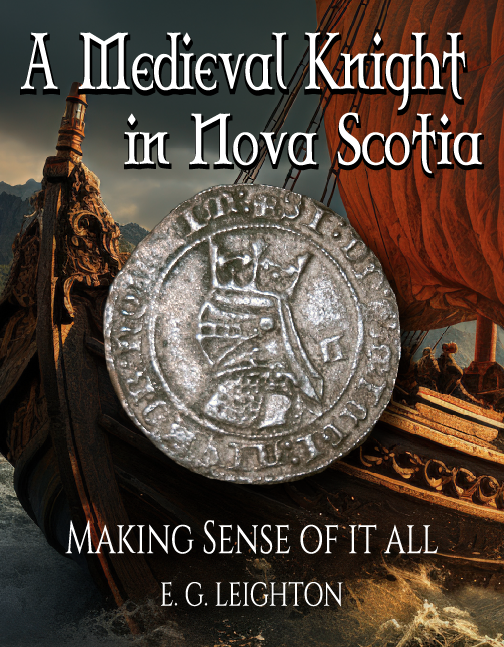
A Medieval Knight explores the probability that Henry Sinclair, Lord of Rosslyn in Scotland and Jarl of Orkney visited and explored Nova Scotia in the years ca. 1400.

324 pages, soft cover, $29.95 from the author. Postage extra. 

Email egl@medievalknight.ca

Available NOW.

.

A very nice comment:


Really excited about this book release! It features a medieval coin my mother found in East Amherst when she was a little girl in the mid 1930s. The author, coin expert Eric Leighton, worked on the book for several years, but he's known about the coin since the early 1990s when he was asked to identify it. 
The coin was minted in Portugal between 1369 and 1371, during the reign of King Ferdinand I, and according to the author it is in nearly uncirculated condition. This means it was likely newly minted when it was dropped in Cumberland County. 
If that isn't interesting enough, fast forward 80 years and the story starts to get really fascinating... 
During his research and investigation of Mom's coin, the author discovered that three more coins minted at the time as Mom's coin were found in the Parrsboro area in the 2010s. This second find is not only shocking but it can only mean the coin discovered by my mother is not an anomaly; that it was, in fact, dropped by people who sailed across the Atlantic more than 600 years ago and explored Cumberland County. The ramifications of this from a historical perspective are astounding.
I still can't get over the fact that these 650-year-old coins were discovered miles away from each other eight decades apart. The odds of that are mind-blowing and so is the realization that this discovery may have just re-written history. My mother would've have been so proud to be a part of it and I love that the book is dedicated in her memory {Susan H.)


A Peek inside

Contents


Foreword   ix

One More Kick at a Battered Old Can 

     A new approach to a very old controversy   xi

Who’s Who The main characters   xviii

1.0 The Zeno Map The reader will be lost without it    1

     1.1. French names on Zeno’s Frislanda   42

                Their strange use by an Italian   

     1.2. Damning the Dated Map and Narrative of 1380   46

     1.3. A matter of focus   54

     1.4. A Confusing title in Lingua Franca   60

2.0. An Introduction to the Zeno Narrative   67

           The source of contention   

     2.1. Zeno’s Arrival at Frislanda What started it all   72

     2.2. Sinclair’s Invasion of Frislanda [Faeros] 73

                Both denial and support for the Narrative 

     2.3. Sinclair’s Problematic Subjugation of Estlanda               

             (Shetlands) A very misunderstood action  84

     2.4. A Couple of Odd Comments Kirkwall and Neome  97

     2.5. Nicolo Goes to Greenland   105

                Shows an existing awareness of that island   

3.0. Zichmni goes West   111

            The Story, the Lore, and the Adventure   

     3.1. The Icaria Question A rational answer   121

4.0. Zichmni crosses the pond Plagued with problems   134

5.0. Charles Godfrey Leland   156

            Who found Norse influence among the Wabanaki   

6.0. Pohl’s Conclusions vs Conjectures   174

           Some good, others not so much   

7.0. The Portage from Baie Verte to Amherst   206

             A natural pathway   

     7.1. Portage from River Hebert to Partridge Island   210

             Created by the hand of a god   

8.0.The Coins Chance finds decades and miles apart   224

9.0 Afterthoughts        233

9.1 Lord, Baron, Earl, Jarl, Duke, or Prince 233

9.2. Am I convinced?  242

9.3. P. S.  245


Appendix A: “Icaria” to Greenland    249

Appendix B: Cunard Crossing Times 251

Appendix C: Map of Greenland     252

Appendix D: Prof. Olson        254

Appendix E: Criticisms of Pohl   257

Appendix F: Sampling of Pohl Reviews      264

Appendix G: Medieval Land & Maritime Trade Routes 266

Appendix H: William Herbert Hobbs      268

Appendix I: Johann Reinhold Forster      271

Appendix J: Ivar Bardsen        273

Appendix K: Comments from the Sinclairs   276

Appendix L: Who was Glooscap     283

Appendix M: Names in the Legends of Glooscap    288

Appendix N: Silas T. Rand    291

Appendix O:The Trinity Question   294

Appendix P: Monumental Errors   299

Also available at: The Age of Sail Museum in Port Greville (Ward's Brook)

Other options will be added as things devevelop.

No, there was NOT a 14th century Venetian cannon at Louisbourg !

Headline


Saw a Utube show re Sinclair, in which the commentator used the discovery of what he called a 14th century cannon in Nova Scotia as evidence of Sinclair’s visit... he showed a welded rod cannon, bound with steel hoops.  The find referred to is usually stated to have been found in Louisbourg Harbour, outside the French fortress. It was a stock image of a 14th century cannon sure enough. It just wasn’t the artifact found. Below is what he was referring to:


The 16th-century breech-loading cannon is considered the oldest relic found at the Fortress of Louisbourg. It predates the 18th-century French fortress, which was built between 1713 and 1745. [Parks Canada. history]


(And: from the world of Ai, overview)


Information regarding a 14th-century cannon at the Fortress of Louisbourg in Nova Scotia appears to be based on an old claim or, more likely, a confusion with16th-century, 17th-century, or 18th-century artifacts found at the site. 


Key Findings on Louisbourg Cannons:

16th-Century Breech-Loader: Early surveys of the area noted a 16th-century breech-loading cannon, which is likely the oldest artillery piece associated with the site, not 14th-century.


"Venetian" Claim: Some anecdotal reports from the early 1990s suggested that Venetian cannons were on display, but these were typically identified as later replicas or items from other periods, rather than 14th-century pieces. 


"Westford Knight"
Pohl, and his followers, have stretched their search for substantiation to some extremes: Oak Island; Newport tower; New Ross castle; Westford knight.
My first issue with the Westford knight is the fact that several “true to life” images are available, and no two are identical. The punch holes used, supposedly, to outline the image should in all cases be the same. The lines so formed may be subject to interpretation and wishful imagination, but the general form of the body ought not to be. 
The supposed effigy is described as on a boulder of andalucite. Historically,  andalucite has been the source of gem quality crystals, known for centuries to the natives, and early colonists since at least the 1640's. Noted as occurring particularly in the Lancaster township of Worchester County of Mass. Westford is about 24 miles NE of Lancaster.  
Natural andalusite crystals commonly grow as euhedral prisms that range from 1 to 20 cm in length, with typical widths of about 0.5 cm. The highly sought-after, gem-quality varieties are usually much smaller, yielding rough materials that result in faceted gemstones weighing 1 to 5 carats.

[These crystals are about the size of a small bean.]
It is likely these crystals could be popped out of the parent rock with a metal punch. This boulder is located on “Prospect Hill”, if that is a clue...................................................

And...

On a Clan Gunn blog we find a strongly adverse opinion of Pohl’s theory:  Chapter 5 - On the (Clan) Gunn 'Westford Knight' embarrassingly silly fantasy story
Clan Gunn literature often claims that its forebears were "Discoverers of America." The story is detailed in the Clan Gunn Heritage Centre in Latheron, Caithness …
The Gunn ‘Westford Knight’ fairy story was meant to have occurred in 1380 when a Sir Henry Sinclair was meant to have sailed from the Orkney Islands to Nova Scotia and beyond, and taken a knighted Gunn with him (the ‘Gunn’ coat of arms / shield is later found carved on a rock at Westford, Massachusetts, USA as part of a larger illustration of the Gunn‘knight’). And so a Gunn was meant to be one of the first white people to discover northern America. There is not a grain of truth in the story. Let’s not forget that Prince Madog of Wales ‘discovered’ America in 1170, before Henry Sinclair! Yes, the Henry Sinclair / Gunn Westford knight fantasy is not the only absurdity in this area…

Ready to Dive Into a Good Book?

Join our community of book lovers today!

Testimonials

A Journey Through Words

Reading the books from this site has transformed my understanding of literature. Each story takes me to another world!

Gift of Stories

I gifted one of the author's books to my friend, and it became their favorite! Highly recommend.

A Must-Read Collection

The unique perspectives and beautiful prose in these books are simply captivating. I can't wait for more!

Get in Touch